Euskal Herria
- Liliana Kotval
- Mar 2
- 6 min read

Updated: Mar 14
A region of complex linguistic history, eloquent dining, and unyielding pride.
By. Liliana Kotval
Let me take you on a virtual journey through one of my most recent trips to a magnificently beautiful region of Spain- Euskal Herria (the Basque Country). Geographically speaking, it is situated on the border between Spain and France, on the coast of the the Bay of Biscay, at the western end of the Pyrenees mountain range. Its location is perfect for a wet, oceanic climate with green, radioactive-looking grass, villages nestled in cliffs, and the origin of Europe´s oldest living language- Euskara.
A region rich with elegant and decadent cuisine, dedicated cultural preservation methods, and natural beauty.

The Euskara Language
Euskara, a language that dates back to the Neolithic period, has unknown origins and is unrelated to any other language family. It is the last remaining descendant of the pre-Indo-European languages of prehistoric Europe. It is fascinating how such a language was able to survive thousands of years in isolation with little influence from the surrounding romance languages.
Looking at the Basque language, it is apparent that it is unlike other European languages. Take the phrases, "Ez horregatik" (you're welcome) or "Komuna, non dago?" (Where are the toilets?) for example.
Or even looking at commonly used words and comparing them with other European languages- Germanic, Latin, and Slavic:
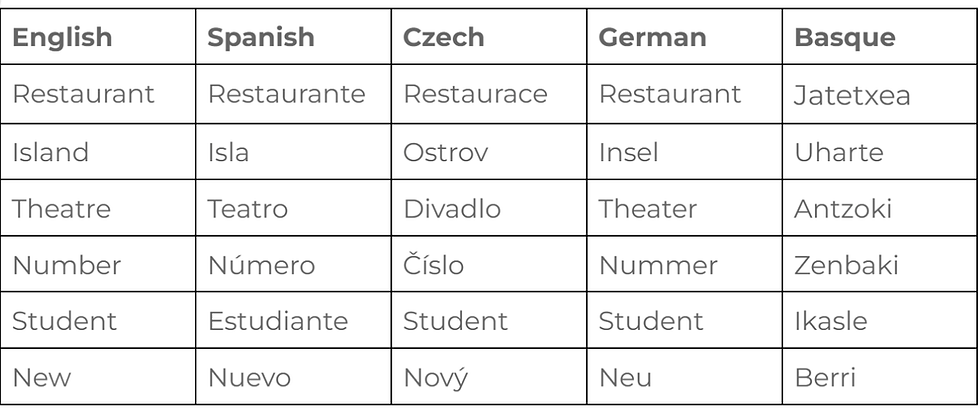
*pronunciation tip as you continue reading: tx/ts sounds like "ch", x sounds like "sh", in sounds like ñ or the "n" in "onion", il sounds like "y".
Furthermore, looking at ancient Basque words, I have found it extremely interesting to see the simplicity of them and better understand what life was like thousands of years ago. Modern-day Basque comes from an earlier, simpler version that used monosyllabic roots, such as these words that are still used today:
- Elur (snow)
- Haur (child)
- Euri (rain)
- Izar (star)
Over history, however, Basque vocabulary has had to adapt to modern times and for once, we can see some linguistic similarities with other European languages:
- Tabakoa (like "tabaco", which is tobacco in Spanish)
- Ordenagailua (like "ordenador", which is computer in Spanish)
- Pantaila (like "pantalla", which is screen in Spanish)
- Kargagailua (like "cargador", which is charger in Spanish)
Its versatility is one of the explanations of its ability to stand the test of time.
As the origins of Euskara date back further than Spanish, it is no surprise that several Spanish words have Basque origins:
- Bakailao --> Bacalao (cod)
- Guiristino --> Guiri (foreigner)
- Izkerra --> Izquierda (left)
- Motxil --> Mochila (backpack)
- Zirimiri --> Sirimir (drizzle)
Today, about one third (around 900,000) of the total Basque population speaks Euskara. It must be noted that the Basque culture is not limited to the Spanish border- the Basque people also originate from Southwestern France. Throughout the entirety of the Basque region in both Spain and France, a variety of dialects are spoken, which is impressive for a language spanning such a small area. Since 1919, there has been an intent to unite the several dialects of Euskara, called euskera batúa in Spanish or Euskaltzaindia in Euskara, to allow for all Basque speakers to be able to understand each other and use a unified version of Euskara. It may seem surprising in such a small land area, but some Basques from the mountains may not be able to understand those speaking the same language some 100 kilometers away. The standardization has mainly used the dialect from Gipuzkoa, the area of San Sebastián, and some are not pleased with this choice.
The Basques take much pride in their culture and language and enforce the learning of the language from an early age. It wasn't always easy to celebrate their culture, however, as during the Spanish fascist dictatorship under Francisco Franco from 1939-1975, minority languages were banned, and those caught speaking their ethnic tongue could be imprisoned, fined, or publicly humiliated. Secret language schools, ikastolaks, were established in hidden areas. Some Basques, before the dictatorship, never even learned Spanish, yet, were forced to speak it. This banishment of Euskara seemed to only heighten the cultural pride. Since the end of the dictatorship, Basque language schools, euskaltegis, have been widely used, with Euskara becoming mandatory in some form or another, in order to bring the language farther away from the extinction it almost suffered. Today, it is not uncommon to even hear some Spanish spoken with grammatical mistakes there, as Euskara has been prioritized in many cities of the Basque Country.
Basque Cuisine
One of the best places, if not the best places in Spain to eat, the Basque country's cuisine mixes culinary delights from the mountains and the sea, cooked with the very best, freshest local ingredients. Sailing is a vital aspect of Basque culture and has been for centuries. Fresh seafood caught in the Bay of Biscay include hake, bonito, spider crab, small cuttlefish, and eels. Land animals can be equally enjoyed for their quality and freshness: "vilagodio" beef and pigeon.


Local bars serve a wide variety of pintxos- small plates of food often ordered with a glass of wine or local apple cider. It is an amazing opportunity to sample a plethora of mouth-watering dishes, and keep the cider flowing.
There's always room for dessert, and the Basques don't disappoint. Many desserts are based on milk, such as deep fried custard slices, fried puff pastry rolls with custard, or my personal favorite- cheesecake. The Basque cheesecake is make with local idiazábal sheep's cheese and is seriously to die for.

Cooking is such a vital aspect of Basque culture that a tradition was established in the middle of the 19th century of creating male cooking clubs, called "txokos". There may be over 1000 txokos in the Basque country, where their members meet to cook, eat, drink, and talk. They are based on trust and cooperation- foods and costs are shared between the group. These gastronomic societies are invitation-only and Basque members-only, and have served as an outlet to preserve Basque culture, especially during the fascist dictatorship, where txokos and ikastolaks with among the few places Basque language and culture could flourish.
San Juan de Gaztelugatxe
One of the most breath-taking views on this trip- San Juan de Gaztelugatxe.
On the top of a high rock in the ocean lies a shrine dedicated to St. John the Baptist. Connected to the coast by a mere bridge with 241 steps, the shrine sits between cliffs, roaring waves, and complete tranquility. I am not going to lie, the hike to get there took hours in total and was absolutely tiring. Even my two travel companions got tired-out (okay, maybe not as much as me). But, nevertheless, the views were definitely worth it.

The shrine that stands today is not the original temple. Battles and fires have caused its rebuilding. It is believed that the first version was built in the 9th century by the Knights Templar- a large organization of devout Christians during the Middle Ages whose purpose was to protect Christianity. In the 12th century it was made into a convent and in the 14th century, a stronghold of resistance against attacks. In 1596, Gaztelugatxe was attacked by Francis Drake, pirate and explorer and the one responsible for much of England´s naval success under Queen Elizabeth I´s reign. He was even the first Englishman to sail around the world.
Does it look familiar to you? Game of Thrones fans will know it as Dragonstone, Daenerys Targaryen's castle. The castle itself was edited, however the cliffs and all are all real.
Another Spanish region checked off my checklist. Spain is such a unique and diverse country. You can choose to travel to a particular climate based on your mood: oceanic Atlantic and rainy climate in Galicia, Asturias, and the Basque Country, Mediterranean in Andalucía and Cataluña, or a desert-like hot and semi-arid climate in Murcia. Each one has its own special characteristics, and I was definitely impressed by the Basque Country. I will be back!

References
"The Basque Country, a Culinary Paradise". Spain.info. https://www.spain.info/en/gastronomy/basque-country-cuisine/
"Basque Gastronomic Societies". North American Basque Association. https://nabasque.eus/gastronomic.html
"Basque Phrases and More: An Introduction to Europe's Most Interesting Language". Devour. 2023. https://devourtours.com/blog/basque-phrases/?cnt=ES
Mendivil, Itziar. "Basque Language: Cool, Beautiful, and Useful Words & Phrases". https://vocab.chat/blog/basque-language.html
"San Juan de Gaztelugatxe, a Castle on the Rock at Sea". Bilbao Bizkaia. https://www.visitbiscay.eus/en/-/san-juan-de-gaztelugatxe-a-castle-on-the-rock-at-sea

Comments