Phenotypic World Map
- Liliana Kotval
- Mar 14
- 7 min read

Updated: Mar 15
Mapping your physical features on a world map.
By. Liliana Kotval
Where do people with curly hair come from? What is the reasoning for their phenotypic differences compared to someone with straight hair? Or, why do some people have pointed noses and others flatter ones?
Our variations in physical (phenotypic) features are not by accident: millions of years of evolution have led us to look the way that we do.
Biology is not a coincidence.
Take a look at this phenotypic map I have created:

Why are certain traits particular to certain areas of the world? Let's now dive into the details...
Hair Texture:

Did you know that the type of hair texture you have depends on the amount of sunlight that was in your ancestor's environment? It has been long discussed as to why we even have hair on our heads; It could be due to sexual selection and most likely, is due to the fact that hair protects our scalp and head from sunlight.
Curls have been an evolutionary advantage for not only growing bigger human brains, but also for protecting the scalp from solar radiation. While all hair types protect the scalp from the sun, curly hair does the best job. Not only does it protect the head from heat, curly hair keeps the scalp cool and reduces the amount of sweating, since curly hair is fluffier and keeps the head aerated. Sweating is costly, as it expends water and electrolytes, so evolutionary speaking, a human is better off having curly hair to conserve its sweat when living in warmer climates.
What about straight hair? Curly hair evolved first in early human ancestors in hotter climates, and at some point, curly hair lost its evolutionary advantage and straight hair was favored in cooler temperatures. Straight hair is better in colder climates because it lays flat on the head and stacks more densely, creating an insulating layer to trap heat. It is not as airy and fluffy as curly hair.
When looking on a world map, regions in hot climates, like Africa, the Middle East, South America, and across the Mediterranean have curlier hair. On the other hand, we can see straight hair most prominent in colder climates across Central and Northern Europe, East Asia, and Japan.
Eye Shape:
When looking at makeup tutorials, you first think about which eye shape you have to know how to accentuate this feature. But why do we have different eye shapes?
In East Asians, Southeast Asians, Polynesians, and Native Americans, there is a slight fold called an "epicanthic fold", which is caused by fat deposits under the skin. This was evolutionary advantageous to protect the eye against the cold or stronger ultraviolet light.
Try going outside on a cold winter day when there is snow all on the ground. The white snow reflects the ultraviolet sunlight and is super bright. You will find yourself squinting. In these type of white, snowy areas, having an epicanthic fold protects the eyes.

Nose Shape:
Humidity and temperature are the main factors that have influenced our nose shapes. Studies have shown that the width of the nostrils is strongly correlated to temperature and absolute humidity of the environment. Why do we even have noses in the first place? Why couldn't we just inhale and smell through holes in the face? Well, one purpose of the nose is to condition and filter inhaled air so that it is warm and moist and favorable to the body.
In drier, colder areas, longer, thinner noses are more advantageous. Narrower nostrils allow for humidifying and warming the air more efficiently. Those living further away from the equator will therefore have more pointed noses with thinner nostrils. On the other hand, those living in more humid and hotter climates closer to the equator have flatter noses with wider nostril width, as the air is already moist and warm.

Height:
Having a shorter, stockier, and thicker body is advantageous in colder climates. Take a look at our Neanderthal ancestors, for instance, who lived during numerous glacial periods. Their robust bodies with shorter limbs and wider rib cages had less surface area and could therefore better retail heat in the freezing cold Eurasian temperatures.
Today, a genetic variant that produces shorter bones is common in European and Asian populations, where Neanderthals once lived.
Taller, thinner bodies can still be seen in hot, arid climates. Africans tend to have taller, leaner physiques. This allows for higher surface area for heat escape via sweating. Not only do taller bodies regulate heat better, but taller Homo sapiens can also see better in grassland climates, and their long legs can run further distances when hunting.
Note: When it comes to body shape such as straight vs. more hourglass figures, these features are more determined by bone structure and hormone-driven fat distribution. Higher levels of estrogen encourages fat storage around the hips and thighs, leading to an hourglass shape. On the other hand, lower estrogen levels and higher cortisol levels lead to fat storage around the abdomen, resulting in a straighter shape.
Breast Size:
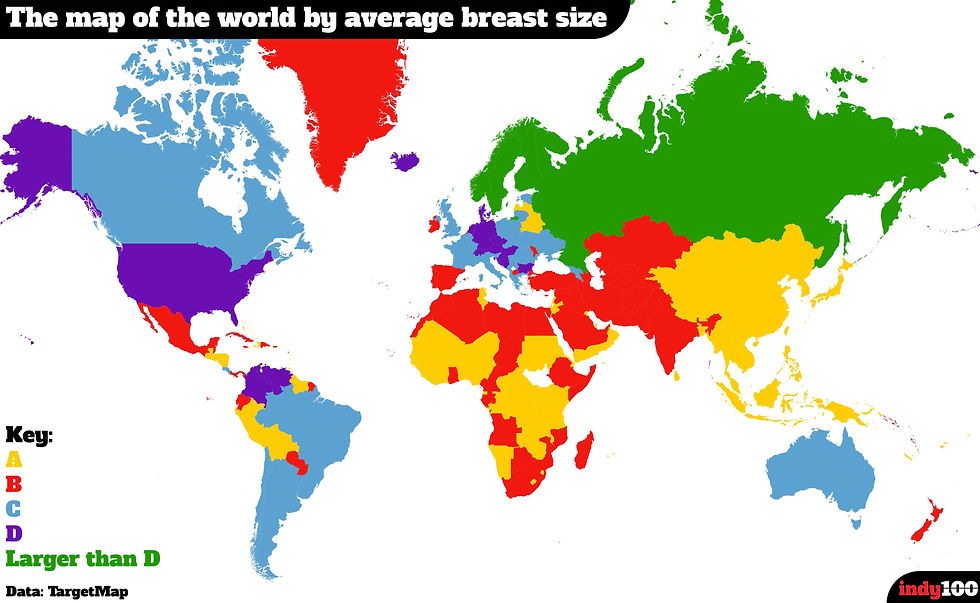
Did you know that humans are the only mammals whose breasts are permanently enlarged? Most mammals only have enlarged breasts while breastfeeding, however for humans, they are always enlarged. Why is this? Well, it is most likely due to sexual selection as well as energy storage. The fluctuation of breast size during the menstrual cycle can also signal ovulation and fertility levels.
But not all breasts are the same. Why are there so many varieties in sizes? Larger breasts are common in colder climates. Increased fatty breast tissue as a response to this colder climate provides an extra layer of fat storage and energy security when food is not so easily accessible. Furthermore, larger breasts provide higher thermal resilience. Not to mention, they are nice and warm for breastfeeding newborns to be around.
Lip Size:
What is the purpose of lips? Birds don't have them. Besides for speech, lips are essential for a sucking reflex that aids in breastfeeding. As for sexual selection, lips also play a huge role: kissing allows us to taste our partner and determine if they taste bad: AKA are unhealthy or diseased and are not fit to mate with.
As for lip size, larger lips, as seen in tropical and warmer regions, have helped with moisture retention. In colder climates, thinner lips are more advantageous to decrease moisture and reduce the chances of frostbite.

Skin, Eye, and Hair Color:
The reason why we have different skin, eye, and hair colors may be a bit more apparent than the previously mentioned physical features. Most of us know that darker skin and eyes have more melanin, which protects the skin and eyes from higher UV radiation. This is why we see those that live in warmer, sunnier climates with darker skin and darker eyes.
However, some of our differences in eye and hair color are due to specific mutations. Did you know that the genes for blond hair and blue eyes are due to separate mutations? Our first blue-eyed ancestor was born with a mutation of the HERC2 gene, the gene responsible for producing brown eye pigment. The world's oldest confirmed blue-eyed person was found to live 7,000 years ago in Spain.
So, all the blue-eyed people in the world can trace their ancestry back to one singular person!

Blond hair was also a genetic mutation caused by a single DNA letter change that led to a reduction in melanin pigment in the hair shaft. The mutation arose about 10,000 to 17,000 years ago in Siberia and Europe. Despite being random, having blonde hair proved to be an advantage in lower-sunlight environments, since it allows for higher vitamin D production.
Contrary to popular belief, having blue eyes and blond hair are not related: they tend to arrive as a package as they are more evolutionary advantageous in colder climates with less sunlight. Not to mention, they have been preferred for attractiveness in sexual selection. Our Neanderthal ancestors gave us DNA variants that allowed our ancestors to adapt to lower UV levels in Eurasia.
On another note, red hair was also a spontaneous mutation that occurred 30,000 to 100,000 years ago in Central Asia. Some Neanderthals also had a different red hair gene. Migrating groups introduced the red hair gene to the British Isles and Western Europe 4,000 years ago, and it proved to be advantageous for better vitamin D production in the darker British climate, which is why we see so many Scots and Irish with red hair today.
As you can see, our physical, phenotypic features are not down to randomization. There is a reason for the way our hair curls or bends, for why we have larger or smaller breasts, for why we have pointed or flatter noses, or for why we have bigger or smaller lips. Nevertheless, some of our most distinctive features, such as blue eyes and blond and red hair, were purely down to genetic coincidence and favorable conditions.

Next time you walk around, take a look at the people around you. What do their physical features tell you about where there ancestors came from?
References:
Goldman, Jason G. "Evolution: Why Do We Have Lips?" BBC. 14 January 2015. https://www.bbc.com/future/article/20150112-why-do-we-have-lips
Hugo, Kristin. "Early Humans Became Tall and Thin 1.5 Million Years Ago to Survive Outside the Forest". Newsweek. 08 November 2017. https://www.newsweek.com/early-humans-became-tall-and-thin-15-million-years-ago-survive-outside-forest-705678
Messer, A'ndrea E. "Nose Form Was Shaped By Climate". PennState. 16 March 2017. https://www.psu.edu/news/research/story/nose-form-was-shaped-climate
Metcalfe, Tom. "Why Curly Hair Was an Evolutionary Advantage". National Geographic. 20 June 2023. https://www.nationalgeographic.com/premium/article/curly-hair-evolutionary-advantage-brain-protect
Pawlowski, Boguslaw and Agnieszka Zelazniewicz. "The Evolution of Perennially Enlarged Breasts in Women: A Critical Review and a Novel Hypothesis". Biological Reviews, Cambridge Philosophical Society. https://doi.org/10.1111/brv.12778
Smithsonian National Museum of Natural History. "Human Characteristics: Bodies". Smithsonian. https://humanorigins.si.edu/human-characteristics/bodies#:~:text=Bodies%20Adapted%20to%20Diverse%20Climates,that%20were%20sleeker%20and%20weaker.
Villazon, Luis. "Why Do People Have Different Eye Shapes?" BBC Science Focus. https://www.sciencefocus.com/the-human-body/why-do-people-have-different-eye-shapes


Comments