Southern Bohemian Myslivost: Naháňka (Stalking) Hunt
- Liliana Kotval
- Mar 2
- 6 min read

Updated: Mar 14
By. Liliana Kotval
The autumn season is a ripe time for hunting in South Bohemia. Locals come together to share the fruit of the hunt and the thrill of the chase. Myslivost, or the Czech word for hunting/gamekeeping, not only involves hunting for food and trophies, but also caring for the forests, keeping tabs on the species, and preserving ecological harmony. Myslivci, or the hunters, form a part of the Czech cultural heritage and have a deeply rooted history within the Bohemian lands.
My dad and strejda (uncle) Miloš were both hunters and fishermen who enjoyed the local traditions. My strejda had hundreds of animal trophies hung in his apartment in Nová Bystřice and even made chandeliers, cutlery, and chairs out of the antlers. He used deer hooves as hangers on a coat rack- pretty inventive.

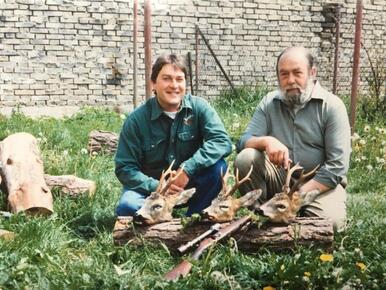


my dad and strejda Miloš after a hunt, early 1990s my dad and a buck, 1991

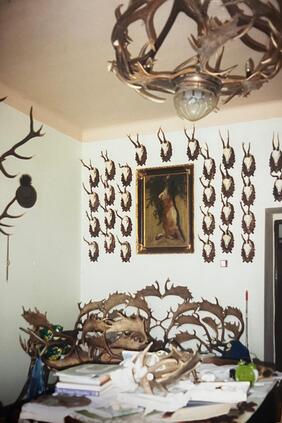

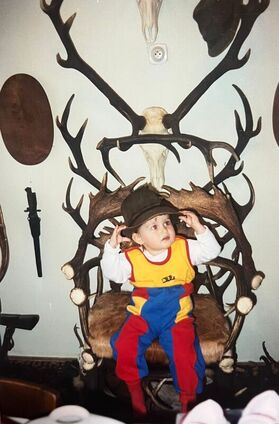
my strejda's hunting trophies, Nová Bystřice, early 1990s me sitting in an antler chair made by my strejda, 2002
Typically hunted in the autumn, wild boars can be an aggressive prey. A naháňka is a stalking hunt of wild boar where the participants split up into two separate groups: one of which is composed of the střelci or the "shooters" and another of the honci or "chasers". Those that are armed go to a certain location in order to wait for the prey to come near and strike. Those that are chasers go to a different location and prepare to enter the forest. The chasers line up side-by-side, with about 200 m between each other, communicating down the line if they should stop, wait, or continue the chase. As the chasers move, they go in the direction of the waiting shooters, banging sticks on trees, shouting "ho, ho" in order to scare the animals to go towards the shooters. This process repeats until the sun sets in various forest locations. At the end of the hunt, the hunted animals are put on display together and respects are paid.

On Saturday 30 November 2024, for the first time, I embarked on this stalking hunt. At 7:30 in the morning I was picked up by Pan Pátek from Nová Bystřice, who invited me to join him on this hunt, and we drove to the nearby village of Hůrky. When we arrived, we entered a barn, which was filled with tables and benches, and other members of that day's hunt. It was very important to shake the hand of everyone already there and the ones entering and greet them. We all sat down at the tables, talked, and had some breakfast: soup and rohlíky (bread rolls). I got the scoop of the process and what would happen that day.

The hunt was organized by the company Myslivecký Spolek Klenová Hůrky who is headed by a man named Jiří.
On this day, there were 30 people in total- 27 men and 3 women, including myself. Of the 30, 12 were shooters and 18 were chasers. There were also 12 furry canine friends. Everyone was equipped with the proper clothing and own hunting gear. All wore traditional green Czech hunting attire, walking boots, a hunter hat, and some type of bright orange garment. The chasers wore more orange, for obvious reasons. This orange clothing is in fact not traditional and was adopted from the U.S. in order to ensure safety during hunts. You will not see hunters wearing any orange however, during celebrations, dinners, banquets, etc. The orange is strictly practical and not a representation of myslivost.
Before the hunt began, we all went outside and stood around one of the leaders, Milan, who gave an opening speech followed by the sound of the halali horn. Everyone lowered their hats.
At 9:00 the group of shooters boarded the back of a tractor to be transported to their waiting area. Once the tractor returned, the group of chasers, which included me, got on and proceeded to a side road near a forest. We formed a long line along the forest border, evenly distancing ourselves from one another. We waited in anticipation to begin the hunt. Once the signal was made, we descended into the rich, natural forest. The dogs were released and began their own search. I observed what the other men did. Pan Pátek entrusted me to a man named Milan (a different one than who did the opening speech), who acted as a guide to teach me the ways of the chasers. When I told him who I was, he said he knew my father, my grandfather, and my uncle, and was happy that I was learning about this tradition. Another chaser, Jarda, kept us company. We laughed and had a great time hiking through the pristine forest. Within the first five minutes, I had already gotten my boots wet and we joked and made fun of it. Milan also taught me to grab some sticks from the forest floor and bang them against each other or against the trees in order to frighten the animals. When there was a rough patch of terrain, he told me to take the same path as the animals do. He used his senses to identify where an animal had recently been.


hunting rear in the back of the tractor honci lining up to prepare for the chase
This went on for 6 hours throughout various types of terrain. The forest was thick and unyielding and we put up with a tiring hike. We took only a few breaks, one with some coffee and chocolate wafers in a clearing, others just taking a pause within the forest. I heard distanced gun shots and the rummaging of animals. I saw many graceful does running and hopping away, with their white tails erect. I also sighted 2 horned moufflons sprinting away and scaling a fence. They were absolutely beautiful. These animals managed to get away, but one unlucky boar met its match with the chasers. It was encircled by the dogs and surrendered to the knife of another chaser, as it is not wise to shoot a gun with dogs in such close proximity to the prey. A string was placed in the boar's mouth and it was dragged away to the rest of the day's catch.

Once the animals are caught, they are quickly field dressed in order to prevent the meat from spoiling. The temperature inside the body is very hot, and needs to be cooled off. Using a knife, some of the people made an incision from the belly all the way to the neck, removing all the organs. The organs were placed in the forest to be left as food for other animals, such as foxes. Some however, including Pan Pátek, took some liver and heart home. After the boars were field dressed, they were hung on the back of a tractor and driven around to air out and cool down some more.
As one of the many traditions of Czech myslivost that must be followed during a hunt, when an animal is hunted, a piece of pine is placed in its mouth as its poslední hryz, or last meal. A similar piece of pine is dipped in the animal's blood and placed in the hat of the one who hunted it. I had asked Pan Pátek why the fox also didn't have a piece of pine in its mouth and he replied saying that it is not a herbivore, but a carnivore, that is why.
Lovu zdar is the congratulatory phrase used to praise a hunter for his catch.
I also learned about the hunting slang, myslivecká mluva, hunters use to describe the body parts of animals and many other hunting terminology. This slang dates back to the middle ages in Bohemia, when peasants hunted for the nobility and created their own hunting speech. Rather than saying oči (eyes), hunters say světla (lights). Rather than saying uši (ears), they use slechý (hearing). Rather than saying krev (blood) they call it barva (color). And, rather than calling it a bilý ocas (the white tip of the tail), they say zrcadlo (mirror).
At the end of the hunt, as the sun began to set, all the hunted animals of the day- 6 boar and 1 fox- were laid down within a frame of pine cuttings, with four ignited wooden logs at the corners. The shooters stood on one end and the chasers on another, lowering their hats and paying their respects to the bountiful hunt. The boar would be sold for meat. The fox is one of the top trophies for a hunter, being a clever, predatory animal.

I will remember this very interesting and exciting day, where the natural human instinct to hike the forest and hunt ignites primal feelings. I truly respect the traditions the hunters uphold and the thankfulness they convey to the animals whose lives they took. This cultural activity may be on the decline in Bohemia in the younger generations, however, I believe this tradition should be honored and the legacy continued.
Stay tuned for further fieldwork on Southern Bohemian myslivost.


Comments